Azerbaijan has experienced a growing real estate market, especially over the past two decades. This dynamic market has been shaped by a variety of developers, mostly local. International construction firms, consultants, local developers, and engineering companies are active players, along with public institutions. The skyline of the capital city, Baku, is dramatically different compared to 20 years ago. Ongoing construction projects include mixed-use real estate developments, shopping malls, 4- and 5-star hotels, business towers, sports facilities, industrial complexes, and more.
The new developments in the real estate market demand the emergence of a dedicated sector: Facility Management. It is no longer feasible to manage modern infrastructure using the traditional approach of relying on a “komendant” (комендант), “bibi” (means aunt), or “axran” (охранник)—the common practice of assigning building services to one or a few individuals. This outdated model fails to meet current technical requirements and customer expectations. Furthermore, the increasing size and complexity of facilities necessitate a more professional and systematic approach, marking a shift to a new era of responsibility.
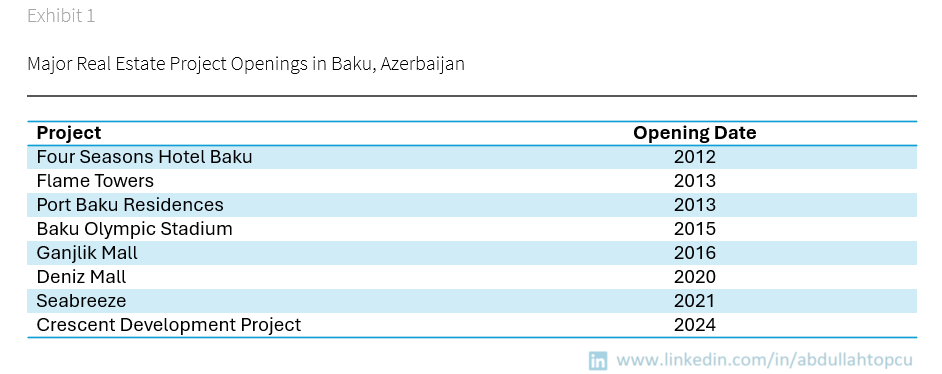
Facility Management (FM) plays a crucial role in ensuring the efficiency, safety, and sustainability of buildings and infrastructure. Services such as maintenance, cleaning, safety and security, landscape management, and pest control are essential for all stakeholders, including investors, residents, customers, guests, public institutions, and the environment.
In the FM sector, operations may vary depending on project type, regulatory requirements, customer expectations, and market needs. FM services can be managed in-house, outsourced, or through a hybrid model. In Azerbaijan, the most common practice is in-house management, as international FM providers have not yet entered the market. A few local service providers are active, primarily in cleaning, catering, and security services. However, there is currently no established integrated facility management (IFM) sector. In contrast, global construction, technology, and machinery brands are active in the country, but only in relation to their own products and services.
Estimating FM Market Potential: Scope, Segments, and Growth Indicators
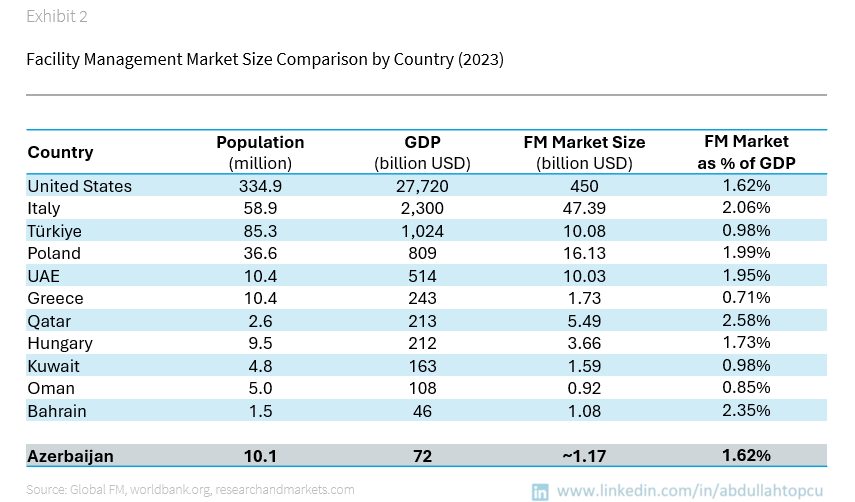
Determining the exact size of the Facility Management (FM) market in Azerbaijan is challenging due to the lack of publicly available data, the absence of sectoral reports, and limited information from companies operating in the field. However, insights can be drawn by analysing data from adjacent and comparable markets.
FM market size analysis may cover various types of services, depending on the definitions and scope applied. According to my study and available resources, the average FM market share accounts for approximately 1.6% of GDP in similar markets. This ratio can be applied to Azerbaijan, taking into consideration the construction sector’s contribution to the national GDP, which is around 4.8%, and the country’s similarity to other emerging real estate markets.
$1.17B Opportunity: Azerbaijan’s Hidden Market
Based on this approach, the estimated size of the FM sector in Azerbaijan is approximately 1.17 billion USD, considering the national GDP was 72.36 billion USD in 2023. This estimation is further supported by a bottom-up analysis, which aligns with the top-down submarket size projection.
To better understand the structure and potential of the facility management (FM) industry in Azerbaijan, the market can be segmented into four distinct subcategories based on client type, geographic distribution, and service demand. These segments reflect varying levels of maturity, scale, and specialization, providing insight into where strategic growth and investment opportunities lie. The following exhibit outlines these FM subsegments, ranging from high-value corporate clients in Baku to broad residential and SME markets across the country.
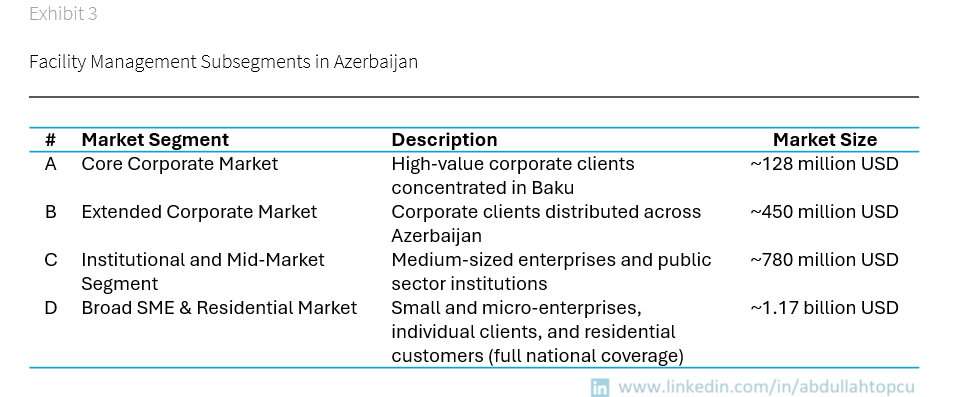
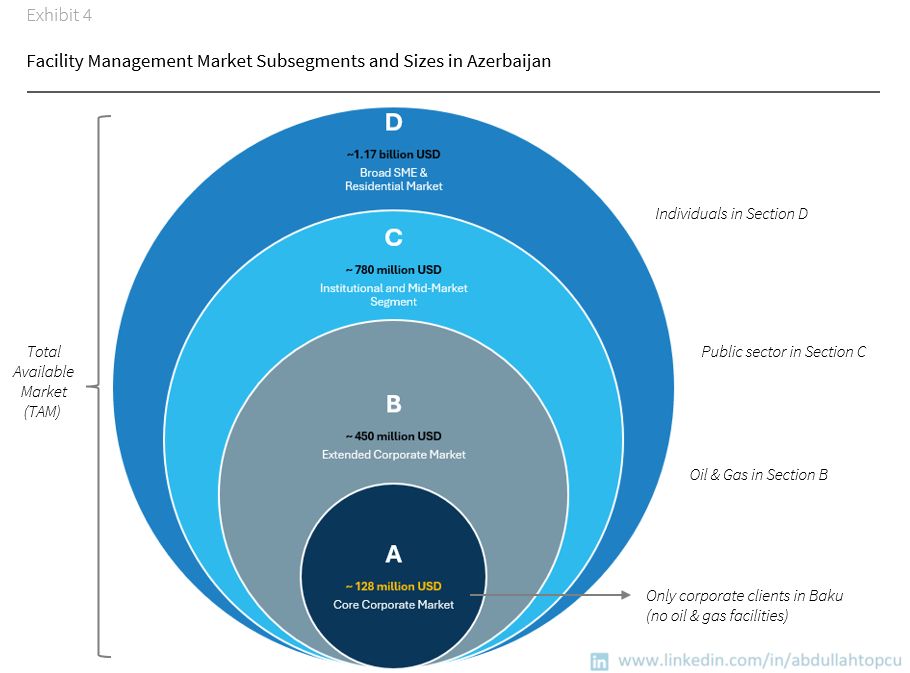
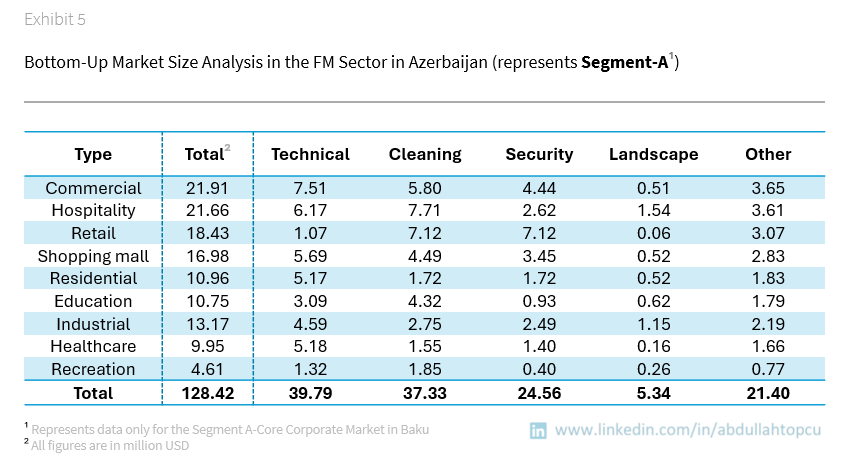
The estimated size of Market Segment A—the Core Corporate Market—is approximately 128 million USD. As shown in the table below, the commercial building sector constitutes the largest share of this segment, driven by the increasing demand for modern office spaces, business centers, and high-grade commercial facilities, particularly in Baku.
The hospitality sector ranks second within this segment, with an estimated FM market size of 21.6 million USD. According to data from the Azerbaijan Statistical Agency, the number of hotel rooms in Baku increased by approximately 25% between 2019 and 2024, reflecting growing tourism, business travel, and international event hosting in the capital.
Based on this growth trend, the FM market size in the hospitality sector can be expected to rise at a similar pace over the next five years. While the global compound annual growth rate (CAGR) for FM services in the hospitality sector is 4.66%, the rate in Azerbaijan may surpass this due to the rapid development of high-end hospitality assets and the country’s increasing international visibility (e.g., hosting events such as COP29, Formula 1).
Therefore, a realistic growth projection for FM services in this segment would likely fall between the historical local development trend and the global average, making the Core Corporate Market a strategically important segment for FM investment and service innovation.
Key Challenges in the Azerbaijani FM Market
There are several clear challenges and opportunities in the facility management (FM) field in Azerbaijan. The country has a total population of around 10 million, with the majority concentrated in the capital city, Baku, and its surrounding areas—home to approximately 3 million people. Baku is also the most developed city in Azerbaijan.
The talent pool for FM professionals in Baku is limited. Although there is a supply of skilled and experienced construction workers, there is a shortage of personnel with backgrounds in facility management and operations. A common approach is to recruit individuals from the construction sector and provide them with the necessary FM training. On the other hand, there is an opportunity to leverage the bilingual and multilingual capabilities of the local workforce. Many well-educated individuals in Azerbaijan speak three or more languages, including English, Russian, and Turkish languages that are closely related to or widely understood alongside Azerbaijani. This linguistic versatility is an advantage for communication and collaboration in both local and regional FM operations.
Technological advancements are truly game changers across the world. In Azerbaijan, there are a few local and multinational initiatives in this field; however, they remain insufficient and are not widely adopted in the real estate sector. Tools such as Computer-Aided Facility Management (CAFM), Computerized Maintenance Management Systems (CMMS), Enterprise Resource Planning (ERP) software, and various SaaS applications are in use, but their adoption is still limited. Moreover, due to the relatively small market size, developing real estate-focused “Prop Tech” applications locally is not currently feasible. However, this could become a viable part of a broader regional development plan within the CIS region.
Market players usually rely on their own methods for facility management operations. While there are some existing regulations and building codes, most are inherited from the Soviet era. Although some of these codes remain useful, the majority are outdated and no longer meet today’s requirements. Another major issue in the sector is the uncertainty surrounding the appropriate standards to follow. Different developers, institutions, public services, and individuals often prefer different standards—such as American (BOMA, NFPA), British (BS, RICS), Turkish (TSE), Russian (SNIP), or European Union standards. This inconsistency can lead to confusion and disorganization across the industry. These standards play a vital role in shaping the real estate market and serve as important reference guides for the facility management sector.
Facility management (FM) operations play an important role in utility consumption for any building. With proper FM organization, it is possible to reduce operational expenses significantly. Utility consumption typically accounts for a large portion of operational expenses (OPEX), comprising approximately 30–40% of the annual budget.
In Azerbaijan, utility rates have increased three times since 2016. The unit price of electricity per kWh has risen from 0.090 AZN to 0.125 AZN (approximately 0.074 USD), representing an increase of around 39%. Similarly, the natural gas price per cubic meter has increased from 0.200 AZN to 0.285 AZN (approximately 0.170 USD), a rise of about 42%.
With a rough estimate, the annual electricity consumption for one square meter of leasable area in any type of real estate unit is around 300 kWh. This figure can easily double or triple due to poor facility management practices. For example, in a 20,000 sqm leasable office area, this could result in an additional 50,000 to 100,000 AZN in monthly utility costs.
Emerging Trends and Opportunities
The FM market has close connection with the construction and real estate sector. Together with the popular sector, real estate in Azerbaijan, there is a massive public investment across the liberated lands in Karabakh and East Zangezur. The government of Azerbaijan invested around 4.5 billion USD for the reconstruction activities in that region. It leads opportunities for the FM activities, especially at the large complexes such as airports, industrial units, energy stations, hotels, etc. Fuzuli International Airport was successfully completed and put into operation in 2021. In addition, the Zangilan International Airport was inaugurated in October 2022. At the same time, Lachin International Airport has been under construction since 2021, which will be the 9th airport in the country and the 3rd airport in the liberated lands.
According to UN sources, 40% of global emissions originate from the real estate sector, with building operations alone accounting for 27.3% of total annual global carbon emissions. Azerbaijan places high importance on environmental issues and took a major step by hosting COP29, the most influential climate summit, in Baku in 2024. Several actions were initiated both before and after the summit. There is a significant opportunity to reduce carbon emissions in the building operations sector through modern and effective facility management strategies. Proper FM operations can support many of the UN Sustainable Development Goals (SDGs), given their strong alignment with the principles of people, planet, and profit. Pioneers in the real estate sector, along with public institutions, have already begun implementing sustainability-focused initiatives to support these goals in Azerbaijan.
Recommendations for Industry Players
The construction sector is emerging in Azerbaijan; however, the facility management (FM) sector is still in its infancy. There are currently no multinational players, no well-organized local companies, and limited regulatory infrastructure. On the other hand, the market is open to new entrants and offers significant development opportunities for existing players.
The human resource pool for the FM sector primarily comes from the construction industry, which has been improving year by year. Many professionals with construction backgrounds are available in the local market and can be transitioned into FM roles with the right orientation and training. Additionally, health and safety awareness—one of the key pillars of the FM sector—is higher than expected due to the strong influence of the oil and gas industry. Hundreds of HSE professionals with IOSH and OSHA certifications are also present in the market.
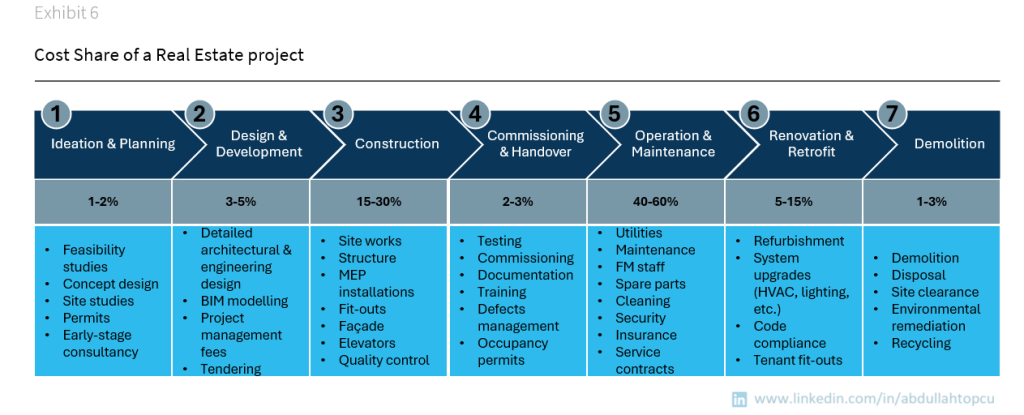
Developers and investors should recognize the critical importance of facility management activities from the outset and collaborate with FM companies both before and after the design phase. This proactive approach can help avoid unnecessary costs throughout the entire real estate lifecycle—from ideation to demolition. As is well known, the most expensive stage of any real estate project is the operational phase. With proper planning and professional FM support, these costs can be significantly minimized.
Moreover, facility management enhances the satisfaction of other stakeholders. FM companies can also provide valuable input during the building design phase, ensuring that local needs and community-specific features are taken into account. This tailored approach supports long-term sustainability and efficiency for all parties involved.
Furthermore, Azerbaijan holds strategic potential as a launchpad for expanding FM businesses into other Commonwealth of Independent States (CIS) countries. As a post-Soviet nation, Azerbaijan shares cultural similarities, a common business mindset, and language familiarity—particularly Russian—with neighbouring CIS markets. These shared elements can significantly ease market entry barriers and strengthen client relationships across the region. In addition, frequent and well-connected flight routes between Azerbaijan and other CIS countries support smooth business travel and operations. For FM companies looking to scale, Azerbaijan offers not only a growing domestic market but also a gateway to regional expansion.
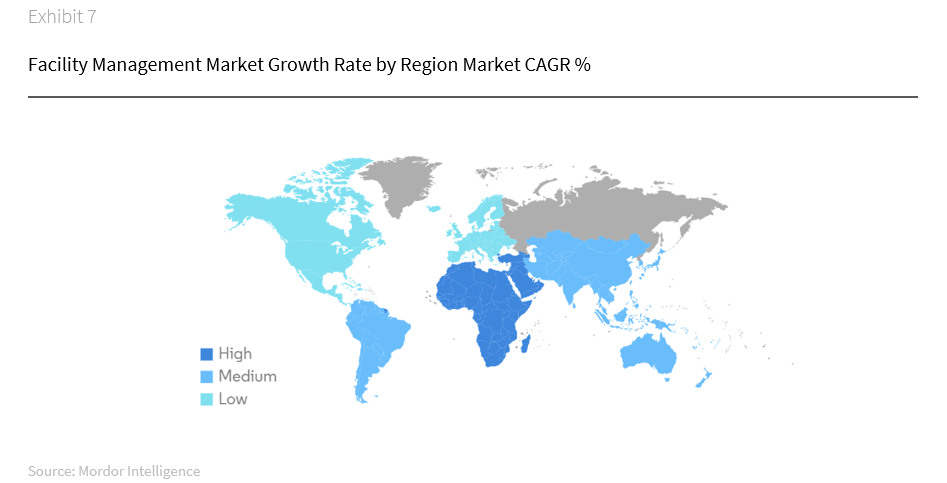
The global facility management market is projected to reach a value of USD 1.39 trillion by 2025 and is expected to grow steadily to USD 1.75 trillion by 2030, reflecting a compound annual growth rate (CAGR) of 4.64% over the forecast period. Among all global regions, the Middle East and Africa (MEA) are poised to experience the most significant growth, with an average CAGR exceeding 6%, making them the fastest-growing regions worldwide. Some FM providers in the Middle East region have already achieved a CAGR of more than 15%. Based on this, the future FM market CAGR in Azerbaijan can be forecasted at around 10% or higher.
Alongside traditional facility management services, Azerbaijan offers growing opportunities in the Public-Private Partnership (PPP) sector. The government has prioritized PPPs to drive infrastructure development and improve public service delivery, creating new avenues for sustainable business growth.
A revised PPP law introduced in 2022, building on the original 2016 framework, has enhanced investor protections, clarified risk-sharing mechanisms, and improved the regulatory environment—encouraging greater private sector participation. Key sectors include healthcare, education, transport, and utilities, where FM companies can engage in the design, build, operate, and maintain (DBOM) phases of projects. These PPP initiatives align with Azerbaijan’s modernization goals and provide long-term, stable opportunities for integrated FM service providers.
Conclusion
Azerbaijan’s facility management sector represents a high-potential, underpenetrated market backed by strong fundamentals: a growing real estate landscape, rising operational complexity, and government-driven infrastructure investment. With no dominant players and increasing demand for integrated FM solutions, early investors have the opportunity to establish a market-leading presence. Strategic entry now can yield long-term returns, regional expansion leverage, and alignment with sustainability-focused capital flows—making Azerbaijan a compelling addition to any emerging market investment portfolio.
Key Takeaways ► ► ►
- The total facility management (FM) market size is around 1.17 billion USD in Azerbaijan.
- The high-value corporate market size is around 128 million USD especially concentrated in Baku.
- There are no multinational FM companies in the market.
- There are no local organized FM companies in the market.
- Cost effective building management trend is emerging since utility prices tend to increase
- Sustainability-centric operations are emerging
- Thanks to being a part of CIS countries, Azerbaijan has a regional growth potential
References
Architecture 2030. (n.d.) Why buildings: Why the built environment. [online] Available at: https://www.architecture2030.org/why-the-built-environment/ [Accessed 20 March 2025].
Caspian Legal Center. (n.d.) Public-private partnerships in Azerbaijan: Legal overview and perspectives. [online] Available at: https://www.caspianlegalcenter.az/news/more/PPP-azerbaijan [Accessed 19 March 2025].
Data Bridge Market Research. (n.d.) Turkey facility management market. [online] Available at: https://www.databridgemarketresearch.com/nucleus/turkey-facility-management-market [Accessed 1 Apr. 2025].
Frost & Sullivan. (2018) Global facilities management market report 2018. [pdf] Available from: Global-FM-Market-Report.pdf [Accessed 10 March 2025].
Government of Azerbaijan. (2024) Government seeks consultants for PPP strategy and legislation development. [online] Infrapppworld.com. Available at: https://www.infrapppworld.com/update/government-of-azerbaijan-is-seeking-consultants-for-development-of-the-ppp-strategy-and-legislation [Accessed 19 March 2025].
International Organization for Standardization. (2018) ISO 41001:2018 Facility management – Management systems – Requirements with guidance for use. Geneva: ISO.
Imdaad (2025) ‘Imdaad Surpasses AED 1 Bn Revenue in 2024 with a 21% YOY Increase’. Available at: https://www.imdaad.ae/news/imdaad-surpasses-aed-1-bn-revenue-in-2024-with-a-21-yoy-increase/ (Accessed: 4 April 2025).
Ismayilova, A. (2022) Analytical policy brief: Assessing the “Great Return to Karabakh”. Baku: Institute for Development and Diplomacy.
ISS Global A/S. (2024) Annual report 2023. Søborg: ISS World. Available at: https://www.issworld.com/ [Accessed 1 Apr. 2025].
KPMG Azerbaijan. (2019) An alternative way of attracting private sector to infrastructure projects. [pdf] Available at: https://assets.kpmg.com/content/dam/kpmg/az/pdf/2019/03/az-en-alternative-way-of-attracting-private-sector-to-infrastructure-projects.pdf [Accessed 8 Apr. 2025].
Marketsandata. (n.d.) Facility management market report. [online] Available at: https://www.marketsandata.com/industry-reports/facility-management-market [Accessed 1 March 2025].
Ministry of Digital Development and Transport of the Republic of Azerbaijan. (2024) 20 years of development path of civil aviation in Azerbaijan – achievements and perspectives. [online] Available at: https://mincom.gov.az/en/media-en/news/20-years-of-development-path-of-civil-aviation-in-azerbaijan-achievements-and-perspectives-article [Accessed 21 Mar. 2025].
Mitie Group plc. (2024) Annual report and accounts 2024. London: Mitie Group. Available at: https://www.mitie.com/investors/reports-results/ [Accessed 29 March 2025].
Mordor Intelligence. (n.d.) Facility management market report. [online] Available at: https://www.mordorintelligence.com/industry-reports/facility-management-market [Accessed 29 March 2025].
Research and Markets. (n.d.) United Arab Emirates facilities management market report. [online] Available at: https://www.researchandmarkets.com/report/united-arab-emirates-facilities-management-market [Accessed 16 March 2025].
Sodexo. (2024) Business and sustainability report – Fiscal 2024. Paris: Sodexo. Available at: https://www.sodexo.com/home.html [Accessed 4 Apr. 2025].
State Tourism Agency of the Republic of Azerbaijan. (n.d.) Tourism statistics. [online] Available at: https://tourism.gov.az/page/statistics [Accessed 9 March 2025].
Tariff (Price) Council of the Republic of Azerbaijan. (n.d.) Utility tariffs. [online] Available at: https://tariff.gov.az/tarifler/kommunal-odenisler [Accessed 30 March 2025].
TechSci Research. (n.d.) UAE facility management market report. [online] Available at: https://www.techsciresearch.com/report/uae-facility-management-market/3170.html [Accessed 1 Apr. 2025].
United Nations Environment Programme Finance Initiative. (n.d.) 40% of emissions come from real estate – Here’s how the sector can decarbonize. [online] Available at: https://www.unepfi.org/themes/climate-change/40-of-emissions-come-from-real-estate-heres-how-the-sector-can-decarbonize/ [Accessed 23 March 2025].
World Bank. (n.d.) Data. [online] Available at: https://data.worldbank.org/ [Accessed 23 March 2025].
World Bank. (n.d.) Türkiye – Data. [online] Available at: https://data.worldbank.org/country/turkiye?view=chart [Accessed 23 March 2025].
World Bank. (n.d.) United Arab Emirates – Data. [online] Available at: https://data.worldbank.org/country/united-arab-emirates [Accessed 23 March 2025].
 ABDULLAH TOPCU
Leave a comment